
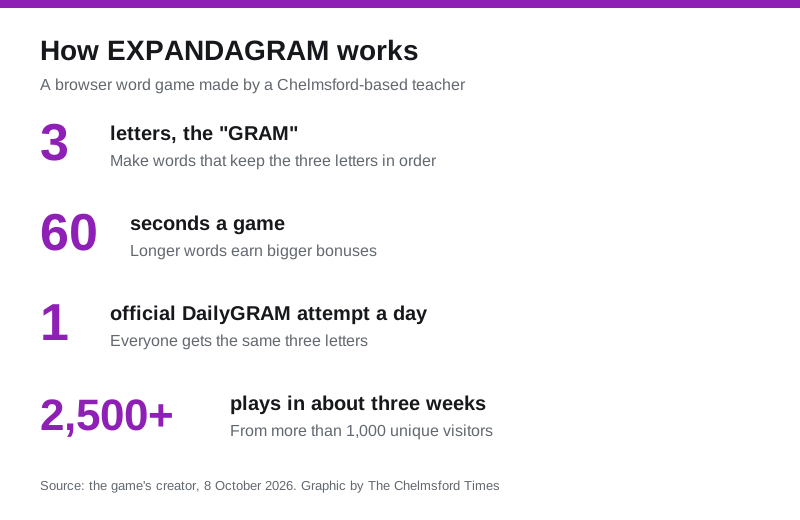
EXPANDAGRAM, a free word game by a Chelmsford teacher, passed 2,500 plays in about three weeks: three letters, 60 seconds, and a daily challenge for everyone.
A word game made by Paul Heard, a Chelmsford-based teacher, has been played more than 2,500 times in about three weeks. EXPANDAGRAM began as a small personal experiment. He says it has drawn more than 1,000 unique visitors since it went online.
The game is free, runs in a web browser and needs no account.
How it works
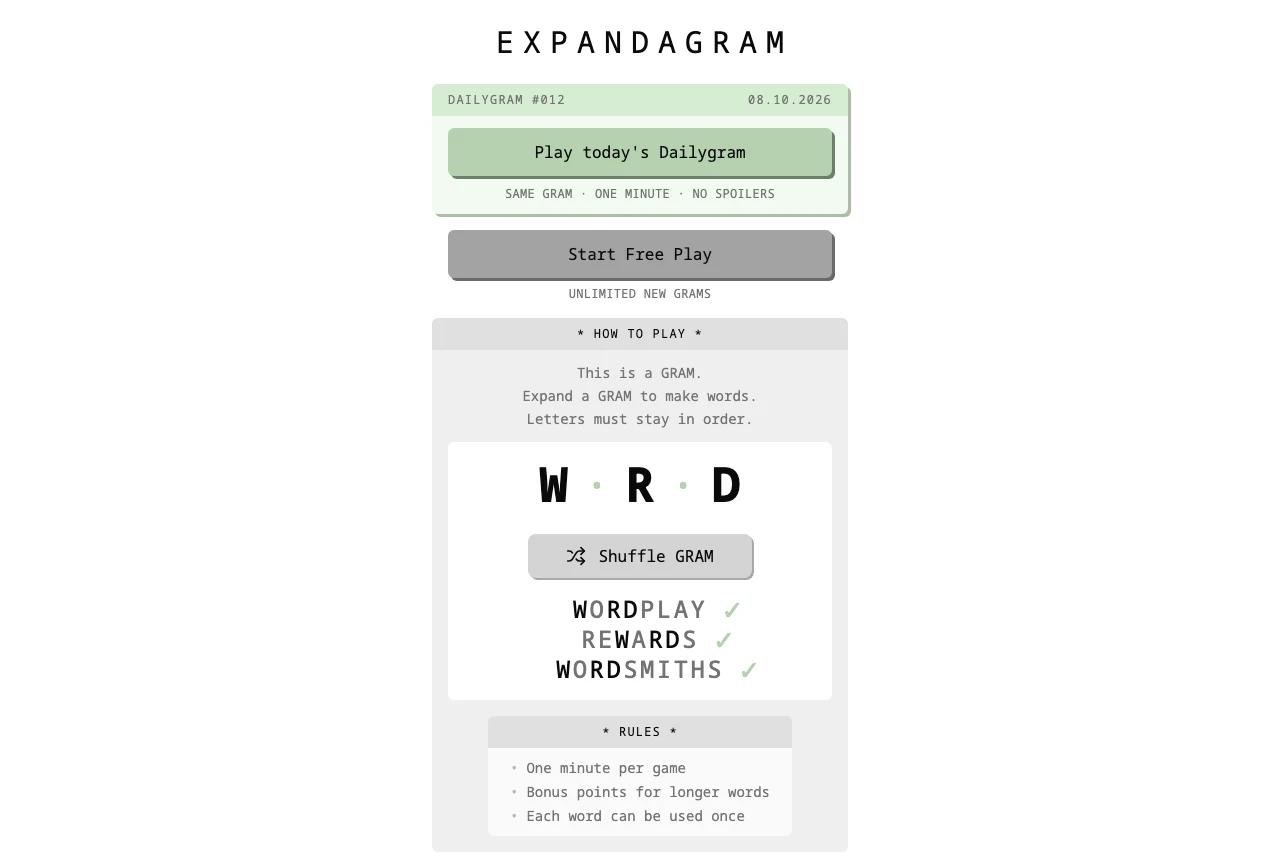
Players get three letters, which the game calls a GRAM. They have 60 seconds to find as many words as they can that keep those three letters in order. The game’s own example is W, R and D, which can become WORDPLAY or WORDSMITHS.
The rules on the home page are short:
- one minute per game
- bonus points for longer words
- each word can be used once
Players can shuffle the GRAM into a different order to open up new words. There are two ways to play:
- Free play: unlimited games, each with a new GRAM
- The DailyGRAM: everyone gets the same three letters and one official 60-second attempt
When we checked on 8 October, that day’s DailyGRAM was number 12.
Number plates, 20 years ago
The idea is about 20 years old. Paul Heard first played it while travelling, using three letters spotted on vehicle number plates as the starting point.
He came back to it years later while working on a much larger digital project.
“I wanted something small that I could use to learn more about taking an idea and turning it into an actual product,” Mr Heard said.
“I thought I’d build a simple prototype, learn from it and move on. The problem was that the game turned out to be much more fun than I expected.”
He shared an early version with friends, pupils and other testers. They replayed it, compared scores and asked how they had done against other players. Several asked for a version where everyone could play the same challenge each day.
That request became the DailyGRAM. Score comparisons and streaks followed. So did something closer to a personal word library: the words a player finds in each daily challenge are saved into their history, building into a vocabulary collection of their own.
“It’s started taking on a life of its own,” he said.
“A lot of what I’m working on now comes directly from people playing it and saying, ‘Wouldn’t it be good if…?’
“That’s been far more useful than trying to plan everything in advance.”
From the classroom to other websites
With a background in teaching, he is exploring how the one-minute game could be used in lessons. The ideas he lists are:
- lesson starters
- vocabulary
- word families
- prefixes and suffixes
- parts of speech
- creative writing
Because every player builds up a history of the words they have found, he says the game could also show how vocabulary changes over time. One example is whether pupils start finding longer words, using more word families, or applying prefixes and suffixes more confidently.
He is also building an embeddable version of the DailyGRAM. Newspapers, magazines, blogs and other websites would add a small piece of embed code, and their readers could play the 60-second challenge without leaving the page. He says it would carry no advertising and need no account. He is looking for a small number of local publishers to test it first.
Private mini-leaderboards are another idea in development, so that friends, families and workplaces can compare their DailyGRAM scores.
Chelmsford already has a stage for this kind of thing this month. The Chelmsford Science Festival has added Playable Worlds, a new fringe strand on gaming, creative technology and digital careers.
Keeping it to one minute
Despite the list of possibilities, he says the core will not change.
“Three letters and 60 seconds is really the whole point,” he said.
“There are lots of things I could build around it, but I don’t want to lose the simplicity that made people enjoy it in the first place.
“I’m still figuring out where it goes, which is probably one of the most fun parts of building it.”
What it means for you
- To play: go to expandagram.com. It is free, works in a browser, and needs no account or download.
- For a daily habit: the DailyGRAM gives everyone the same three letters, with one attempt each.
- For teachers: Mr Heard is exploring classroom uses, from lesson starters to work on prefixes and suffixes.
- To follow the build: he records his own DailyGRAM attempt each day and talks through new features on Instagram.
Sources
- Paul Heard, the game’s creator, by email to The Chelmsford Times, 8 October 2026, for the game’s history, the visitor and play figures, the plans for an embeddable DailyGRAM, mini-leaderboards and classroom use, and all quotes.
- How to play EXPANDAGRAM, the creator’s video on YouTube, for the rules and a full game.
- EXPANDAGRAM, read 8 October 2026, for the rules, the WORD example and the DailyGRAM number.
- EXPANDAGRAM on Instagram, the creator’s build diary.
Have your say